How Does Generative AI Work ?
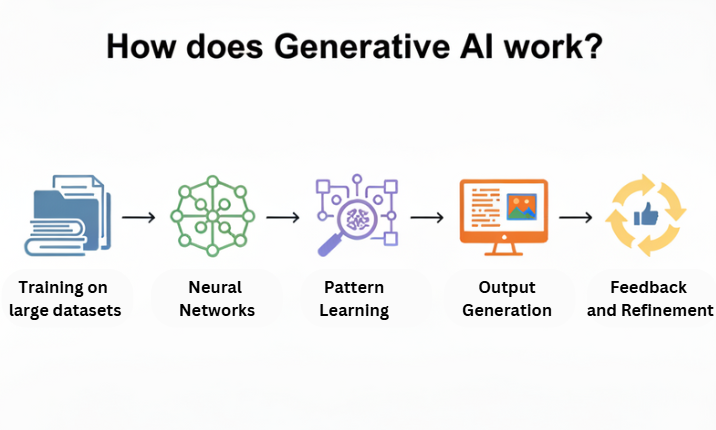
Generative AI is a subset of artificial intelligence designed to create new content such as text, images, music, or code by learning patterns from existing data. Unlike traditional AI that predicts or classifies, generative AI can generate entirely new outputs that mimic human-like creativity.
1. Learning From Data
Generative AI models are trained on large datasets containing examples of the type of content they will generate. For instance, a text-based generative AI like ChatGPT learns from billions of sentences, while image-based models like DALL·E or MidJourney study millions of pictures. During training, the AI analyzes patterns, structures, and relationships in the data to understand how content is typically formed.
2. Neural Networks and Deep Learning
Most generative AI relies on deep learning techniques, particularly neural networks. These networks consist of layers of nodes (like artificial neurons) that process information in steps. Transformers are a popular architecture used in modern generative AI. They excel at handling sequential data, making them highly effective for language and text generation. For images, models often use diffusion networks or GANs (Generative Adversarial Networks) to progressively refine outputs until realistic content is produced.
3. Generating New Content
Once trained, the model can generate content based on input prompts. For example:
-
ü A text prompt like “Write a blog about AI in healthcare” produces coherent paragraphs.
ü An image prompt like “A futuristic city at sunset” generates a realistic or artistic visual.
The AI predicts the most probable next element in a sequence (words, pixels, or notes) and iteratively constructs new content. Advanced models can also refine outputs, adjust styles, and incorporate user feedback.
4. Fine-Tuning and Adaptation
Conclusion
Generative AI works by learning patterns from large datasets, using deep neural networks to understand structure, and then creating new content through prediction and refinement. Its ability to generate human-like text, images, and other media makes it a powerful tool for creativity, automation, and problem-solving in industries ranging from marketing to software development.
STLabs India
Leading IT training institute providing industry-ready courses with 100% placement assistance.