What is the difference between AI and generative AI?
What Is the Difference Between AI and Generative AI?
Artificial Intelligence (AI) has become one of the most transformative technologies of the modern era. From recommendation systems and voice assistants to autonomous vehicles and fraud detection systems, AI is being used in countless applications.
In recent years, Generative AI has emerged as one of the most exciting branches of artificial intelligence. Tools like AI chatbots, image generators, and AI coding assistants have shown how machines can now create content instead of just analyzing data.
Although the terms AI and Generative AI are often used interchangeably, they represent different concepts. Understanding the difference between them is essential for students, developers, and professionals entering the field of artificial intelligence.
What Is Artificial Intelligence (AI)?
Artificial Intelligence refers to the broader field of computer science focused on building systems that can perform tasks that typically require human intelligence.
AI systems analyze data, identify patterns, and make decisions or predictions based on that data.
Common Capabilities of AI
AI technologies are commonly used for:
- Data analysis and pattern recognition
- Predictive analytics
- Image and speech recognition
- Recommendation systems
- Fraud detection
- Autonomous decision-making
Examples of Traditional AI Applications
Some common examples of AI include:
- Email spam filters
- Netflix or Amazon recommendation engines
- Face recognition systems
- Voice assistants like Siri or Alexa
- Self-driving vehicle technology
In most cases, traditional AI focuses on analyzing data and making predictions rather than creating new content.
What Is Generative AI?
Generative AI is a specialized subset of artificial intelligence that focuses on generating new content such as text, images, audio, video, and even computer code.
Instead of only analyzing existing data, generative AI models learn patterns from large datasets and use that knowledge to create entirely new outputs.
What Generative AI Can Create
Generative AI systems can produce:
- Written content and articles
- Images and artwork
- Software code
- Music and audio
- Videos and animations
- Chatbot conversations
These systems rely on advanced machine learning models such as large language models (LLMs) and deep learning networks.
Popular Examples of Generative AI
Examples of generative AI tools include:
- AI chatbots and conversational assistants
- AI image generation tools
- AI video generation systems
- AI writing assistants
- AI coding assistants
These technologies have dramatically changed how businesses automate creative and knowledge-based tasks.
Key Differences Between AI and Generative AI
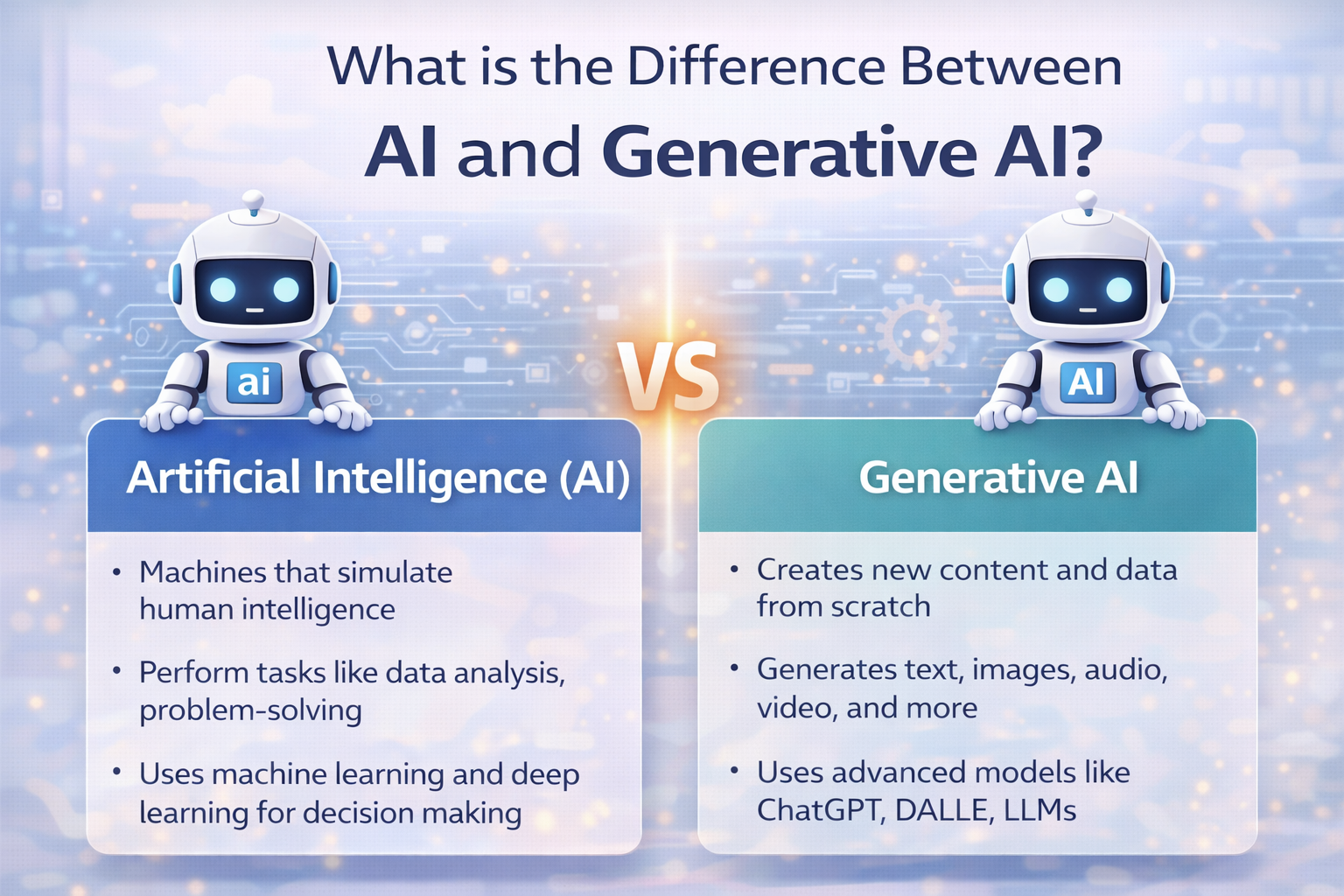
Although Generative AI is part of the broader AI field, there are important differences between the two.
| Feature | Artificial Intelligence (AI) | Generative AI | ||||
|---|---|---|---|---|---|---|
| Purpose | Analyze data and make predictions | Create new content | ||||
| Output | Decisions, classifications, predictions | Text, images, audio, code | ||||
| Data Usage | Uses data to detect patterns | Uses data to learn patterns and generate new outputs | ||||
| Applications | Fraud detection, recommendations, automation | Content creation, chatbots, AI assistants | ||||
| Technology | Machine learning, rule-based systems | Deep learning, large language models |
In simple terms:
AI analyzes data, while Generative AI creates new data or content.
Why Generative AI Is Growing So Fast
Generative AI is gaining massive popularity because it can automate creative and complex tasks that were previously done only by humans.
Some key reasons for its rapid growth include:
- Increased computing power
- Availability of large datasets
- Advances in deep learning models
- Business demand for automation
- Rise of AI-powered applications
Companies are now using generative AI for marketing content creation, customer support automation, software development, and business intelligence.
The Future of AI and Generative AI
Both AI and Generative AI will continue to evolve and work together to power the next generation of intelligent systems.
While traditional AI will remain important for data analysis, prediction, and decision-making, generative AI will expand capabilities in content creation, automation, and intelligent assistants.
Industries such as healthcare, finance, education, entertainment, and software development are expected to see massive innovation powered by these technologies.
Conclusion
Artificial Intelligence is a broad field focused on enabling machines to perform intelligent tasks such as analyzing data and making decisions. Generative AI, on the other hand, is a specialized branch of AI that focuses on creating new content using advanced machine learning models.
Understanding the difference between AI and Generative AI is essential for anyone interested in the future of technology. As businesses continue to adopt AI-powered solutions, professionals with knowledge of both traditional AI and generative AI technologies will be in high demand across industries.
STLabs India
Leading IT training institute providing industry-ready courses with 100% placement assistance.