
Skip to content
Limited offer

Save up to ₹25,000 on select courses

View offers
Not sure which course fits you? Talk to an expert View all 84 courses
Software Testing 5000 Rs OFF

Best Playwright Training Institute in UAE

Enroll in Playwright training in UAE. Learn automation testing online with certification, real-time projects, and expert guidance.

  • 45-60 Hrs
  • Intermediate
  • Online & classroom
  • Certificate
Enroll now
4.8/5 from 1,568+ reviews on Course Report
Playwright Automation with JavaScript Training Program

Our learners work at

  • Amazon
  • IBM
  • HCLTech
  • MetLife
  • Emerson
  • Birlasoft

What's included

  • Duration: 45-60 HrsLive, instructor-led sessions
  • Expert industry trainersTrainers who work in the field
  • Recorded sessionsRevisit any class you missed
  • E-learning accessNotes and material in the LMS
  • Hands-on live projectsReal-world assignments for your portfolio
  • Free assessmentsTest your knowledge as you go
  • Post-training supportDoubt-clearing after the course
  • Course certificateIssued by STLabs India on completion
  • 100% placement assistanceResume, mock interviews, referrals

About this course

Best Playwright Training Institute in UAE

Master Playwright Automation Testing with Online Training in UAE

Looking for the best Playwright training institute in UAE? Our Playwright Online Training Course is designed to help students and professionals learn modern automation testing using Microsoft Playwright, one of the most in-demand tools in today’s QA industry.

With hands-on projects, real-time scenarios, and expert guidance, this course enables you to become a job-ready automation tester in UAE, capable of working on enterprise-level applications.

Playwright is widely used for cross-browser automation testing and is rapidly replacing traditional tools due to its speed and reliability.


Why Learn Playwright in UAE?

The demand for automation testers in cities like Dubai and Abu Dhabi is growing as companies adopt Agile and DevOps practices.

Key Benefits:

  •     · Supports Chromium, Firefox, and WebKit browsers
  •     · Faster and more reliable than traditional tools
  •     · Built-in auto-wait and smart selectors
  •     · Supports headless testing
  •     · Easy integration with CI/CD pipelines
  •     · API and UI testing in one framework

Professionals with Playwright automation skills in UAE are highly valued across industries like banking, e-commerce, and IT services.


What You Will Learn in Playwright Training

Our Playwright course in UAE covers everything from basics to advanced automation.

Playwright Fundamentals

  •     · Introduction to Playwright
  •     · Installation and setup
  •     · Understanding Playwright architecture

Playwright with JavaScript / TypeScript

  •     · Writing automation scripts
  •     · Locators and selectors
  •     · Handling dynamic web elements

Advanced Automation Concepts

  •     · Cross-browser testing
  •     · Parallel execution
  •     · Handling frames, alerts, and popups
  •     · Debugging and test optimization

API Testing with Playwright

  •     · API automation basics
  •     · Request and response validation

Framework Development

  •     · Playwright Test Runner
  •     · Page Object Model (POM)
  •     · Data-driven testing

CI/CD Integration

  •     · Jenkins integration
  •     · GitHub Actions
  •     · Test reporting and dashboards

Real-Time Projects in Playwright Course

Practical learning is a core part of our Playwright automation training UAE.

Projects Include:

  •     · E-commerce automation testing
  •     · Login and user authentication flows
  •     · API automation framework
  •     · End-to-end testing project

These projects help you gain real-world experience and improve job readiness.


Who Should Join This Course?

This Playwright online training in UAE is ideal for:

  •     · Manual testers moving to automation
  •     · QA engineers and software testers
  •     · Developers interested in testing
  •     · Fresh graduates entering IT field

Career Opportunities in UAE

After completing the Playwright training course in UAE, you can apply for:

  •     · Automation Test Engineer
  •     · QA Automation Engineer
  •     · Software Tester
  •     · SDET (Software Development Engineer in Test)

    · Playwright skills are highly demanded in modern testing environments.


Playwright Automation Engineer Salary in UAE

Approximate salary ranges:

  •     · Entry Level: AED 6,000 – AED 10,000 per month
  •     · Mid-Level: AED 10,000 – AED 18,000 per month
  •     · Senior Level: AED 18,000 – AED 30,000+ per month

    · Salary depends on experience, company, and skill level.


Why Choose the Best Playwright Training Institute in UAE?

When selecting the best Playwright training institute in UAE, look for:

  •     · Experienced industry trainers
  •     · Hands-on live projects
  •     · Updated curriculum (latest Playwright features)
  •     · Resume & interview preparation
  •     · Certification support

A strong training program ensures you gain practical and job-ready skills.


Enroll in Playwright Online Training in UAE

Join our Playwright online course in UAE and build a successful career in automation testing. Learn modern tools, work on real projects, and prepare for high-demand QA roles.

Curriculum

6 modules designed by industry experts

(Modern Web Automation | API Testing | CI/CD | Generative AI Integration)

By STLabs India

This curriculum is designed according to current 2026 automation industry demand, focusing on Playwright with JavaScript (Node.js), modern web testing, framework design, API automation, DevOps integration, and AI-assisted automation techniques.
- JavaScript Basics & Syntax
- ES6+ Features
- Variables, Functions & Arrow Functions
- Promises & Async/Await
- Exception Handling
- Modules & Imports
- Node.js Basics

Outcome: Build strong JavaScript foundation for automation.
- What is Automation Testing?
- Why Playwright?
- Playwright vs Selenium
- Playwright Architecture
- Installing Playwright with Node.js
- Setting Up Project Environment
- Launching Browsers (Chromium, Firefox, WebKit)
- Locators & Selectors
- Handling Dynamic Elements
- Playwright Assertions
- Working with Forms & Inputs
- Wait Strategies
- Basic Test Execution

🛠 Practical: Automating real-time web applications.
- Handling Alerts, Frames & Windows
- File Upload & Download
- Mouse & Keyboard Actions
- Handling Dynamic Web Tables
- Cross-Browser Testing
- Headless Execution
06 Module 5: Playwright Test Runner & Framework Design
Sign up free to see the full curriculum 1 more modules open after you register.

Who this course is for

  • Fresh graduates Start your career with skills employers hire for.
  • Working professionals Upskill for a promotion, a new role or a better salary.
  • Career switchers Move into tech from any background with a structured path.
  • Entrepreneurs Learn enough to build and run the tech side of your business.

Your certificate
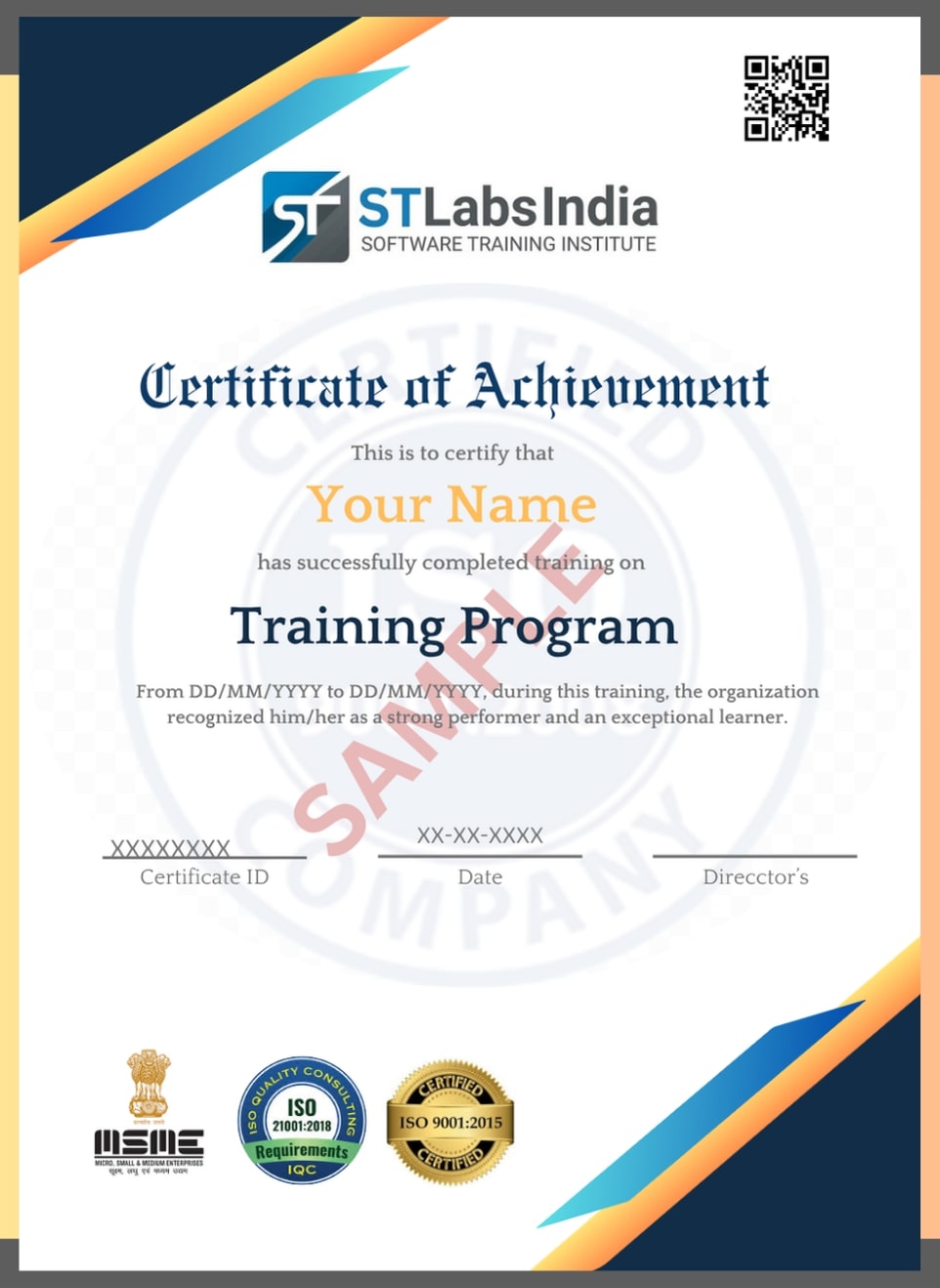
Sample STLabs India course completion certificate
  • Issued by STLabs IndiaAwarded on completing the course and the assessment of your practical projects.
  • Lifetime validityYour certificate does not expire and shows the skills you practised.
  • How to earn itComplete all modules, take part in the hands-on labs and pass the final project review.
  • Why it helpsStrengthens your resume and portfolio and prepares you for related global certifications.

Frequently asked questions

Playwright is an open-source browser automation framework developed by Microsoft. It allows testers and developers to automate web applications across Chromium, Firefox and WebKit browsers. It supports end-to-end testing, browser interactions, API testing and modern automation workflows.
Both Playwright and Selenium are useful automation technologies. Playwright offers built-in auto-waiting, browser context management, modern debugging tools and an integrated test runner. Selenium has a mature ecosystem and broad adoption across enterprise projects. The right choice depends on project requirements.
JavaScript or TypeScript knowledge is required when developing Playwright automation scripts using these languages. Our training program includes JavaScript fundamentals to help candidates understand the programming concepts needed for automation.
Yes. Manual testers can learn Playwright by first understanding JavaScript fundamentals, followed by browser automation, locators, assertions, framework development and API testing.
Playwright is gaining adoption in modern web automation projects because of its cross-browser capabilities, modern testing features and integration with JavaScript and TypeScript ecosystems. Learning Playwright can help QA professionals expand their automation skill sets.
Playwright and Cypress are modern web automation frameworks. Playwright supports Chromium, Firefox and WebKit and offers multi-browser automation. Cypress has its own distinctive browser testing architecture and developer experience. Both are used for end-to-end web application testing.
Yes. Playwright provides APIRequestContext, which allows testers to send HTTP requests, validate responses, manage authentication and integrate API testing with UI automation workflows.
Yes. Playwright tests can be executed through Jenkins pipelines. Automation suites can run as part of CI/CD workflows, with test reports and execution results made available to development teams.
AI is changing automation development by helping generate test scripts, suggest locators, analyze failures and improve testing productivity. However, understanding application behaviour, designing test strategies, validating results and maintaining automation frameworks still require technical expertise and human judgment.
Yes. STLabs India provides placement assistance, resume guidance, mock interviews and career preparation support to help students prepare for relevant automation testing opportunities.
Our training program emphasizes hands-on exercises, practical assignments and framework development. Students may also get opportunities to work on live projects and paid internships, depending on project availability and eligibility.
Yes. Prior Selenium knowledge is not mandatory. Candidates with basic programming knowledge can learn Playwright directly through our structured JavaScript and automation training program.
To learn Playwright automation from scratch, start with JavaScript fundamentals, including variables, functions, arrays, objects, promises, and async/await. Then learn Playwright installation, browser handling, locators, assertions, and test execution. Gradually move towards advanced concepts such as Page Object Model (POM), fixtures, data-driven testing, API testing, reporting, and CI/CD integration. Practising on real applications and building an automation framework will help you gain practical experience.
The learning duration depends on your programming knowledge and previous testing experience. A beginner may need approximately 6–10 weeks of consistent practice to understand the fundamentals and build a basic automation framework. Learning advanced concepts, real-time project implementation, API testing, and CI/CD integration may require additional practice.
Yes. Playwright is gaining popularity in India's software testing and automation industry because of its support for modern web applications, cross-browser testing, parallel execution, and reliable automation. Many organisations are exploring or adopting Playwright as part of their automation strategy. Knowledge of JavaScript, API testing, Git, CI/CD, and framework development can further strengthen your profile.
The salary depends on experience, programming skills, automation framework knowledge, location, and company requirements. Playwright is often combined with JavaScript or TypeScript, API testing, and CI/CD skills.
Yes, learning Playwright can help you apply for roles such as Automation Tester, QA Automation Engineer, Software Test Engineer, and Playwright Automation Engineer. However, learning only Playwright may not be sufficient. Employers generally look for knowledge of manual testing, JavaScript or TypeScript, framework development, API testing, Git, CI/CD, debugging, and real project experience. Building practical projects and preparing for interviews can improve your job prospects.
Both Selenium and Playwright are useful automation tools, but they have different strengths. Recommendation: Beginners interested in modern web automation can start with Playwright. Selenium is also valuable, particularly for organisations with existing Selenium frameworks and established automation projects.
To build a Playwright automation framework, first create a Node.js project and install Playwright. Then organise the project into structured folders for test cases, page objects, test data, utilities, configurations, and reports. A typical framework includes: - Playwright configuration and browser settings. - Page Object Model (POM). - Reusable functions and custom fixtures. - Test data management and parameterisation. - Assertions and error handling. - Screenshots and execution logs. - HTML reporting. - API testing integration. - Git and GitHub integration. - CI/CD pipeline configuration. Start with a small application and gradually add reusable components to make the framework scalable and maintainable.
Playwright works with several tools that help build, execute, manage, and maintain automation frameworks. Some commonly used tools include: - Visual Studio Code: Writing and debugging automation scripts. - Node.js and npm: Managing the JavaScript environment and packages. - Git and GitHub: Source code management and collaboration. - Postman: API exploration and manual API testing. - Jenkins and GitHub Actions: Continuous integration and execution. - Allure Report: Test execution reporting. - JIRA: Defect and project management. - GitHub Copilot: AI-assisted code generation and test automation development. The right combination depends on project requirements and the team's technology stack.
AI is changing software testing, but it is unlikely to eliminate the need for skilled automation testers. AI can help generate test cases, create automation scripts, analyse failures, suggest locators, and support test maintenance. However, understanding business requirements, identifying risks, validating application behaviour, and making testing decisions still require human expertise. Testers who learn AI-assisted testing, Playwright, API automation, and automation framework development can prepare themselves for evolving QA roles.
GitHub Copilot can assist Playwright developers in writing and improving automation scripts. You can use it to generate test cases, create page objects, suggest locators, write reusable functions, debug errors, and generate API test scripts. For better results, provide Copilot with clear requirements, application details, existing framework structure, and expected test behaviour. Always review and execute AI-generated code before using it in your automation framework.
Playwright interviews generally cover basic concepts, JavaScript, automation framework development, debugging, and real-time scenarios. Important topics include: - What is Playwright, and how does it work? - What is the difference between Playwright and Selenium? - What are locators in Playwright? - What is the difference between locator() and getByRole()? - What is auto-waiting? - What are fixtures in Playwright? - What is Page Object Model (POM)? - How do you handle dropdowns, alerts, and multiple tabs? - How do you upload and download files? - How do you execute tests in parallel? - How do you capture screenshots on test failure? - How do you perform API testing using Playwright? - How do you integrate Playwright with Jenkins or GitHub Actions? Practical framework-building and debugging questions are also important for experienced candidates.
Self-healing automation is an approach in which an automation framework attempts to recover when an existing locator stops working because of changes in the application's UI or DOM. For example, if a button's XPath changes, a self-healing system can inspect the live DOM, identify the intended element using attributes, accessible names, labels, and surrounding elements, and generate an alternative locator. An AI-powered self-healing framework may include: 1. Test execution monitoring. 2. Failure analysis. 3. DOM inspection. 4. AI-based locator generation. 5. Element matching and ranking. 6. Locator validation. 7. Retry execution. 8. Repository update and audit reporting. The updated locator should be validated before being saved to the object repository. Self-healing should not automatically hide genuine application defects or incorrect test expectations.

Still have a question?

Start your Playwright Automation with JavaScript Training Program journey

Choose a weekday, weekend or fast-track batch. Send a request and our team will call you back.

Enroll at ₹15,000
₹15,000 ₹20,000
Enroll now